PAX-1 is building on a permit first granted to a 15‑acre housing development.
The developer used Governor Shapiro's Permit Fast Track Program to speed up their permits. Rather than get their own stormwater permit, which controls runoff and erosion during construction, they kept amending a housing permit initially granted in 2018 for 58 homes on 15.3 acres. After four amendments, it now covers the 693-acre site planned for 16 hyperscale data centers. No outside party has ever assessed the environmental impact of the whole project. View the fast-track meeting notice
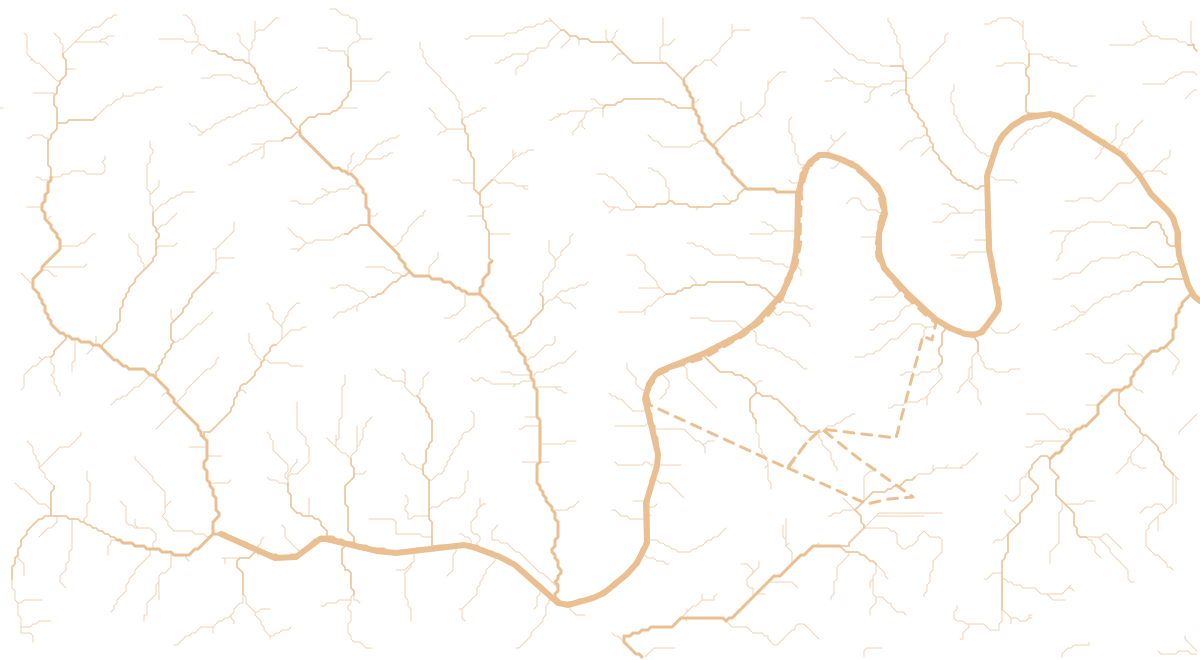
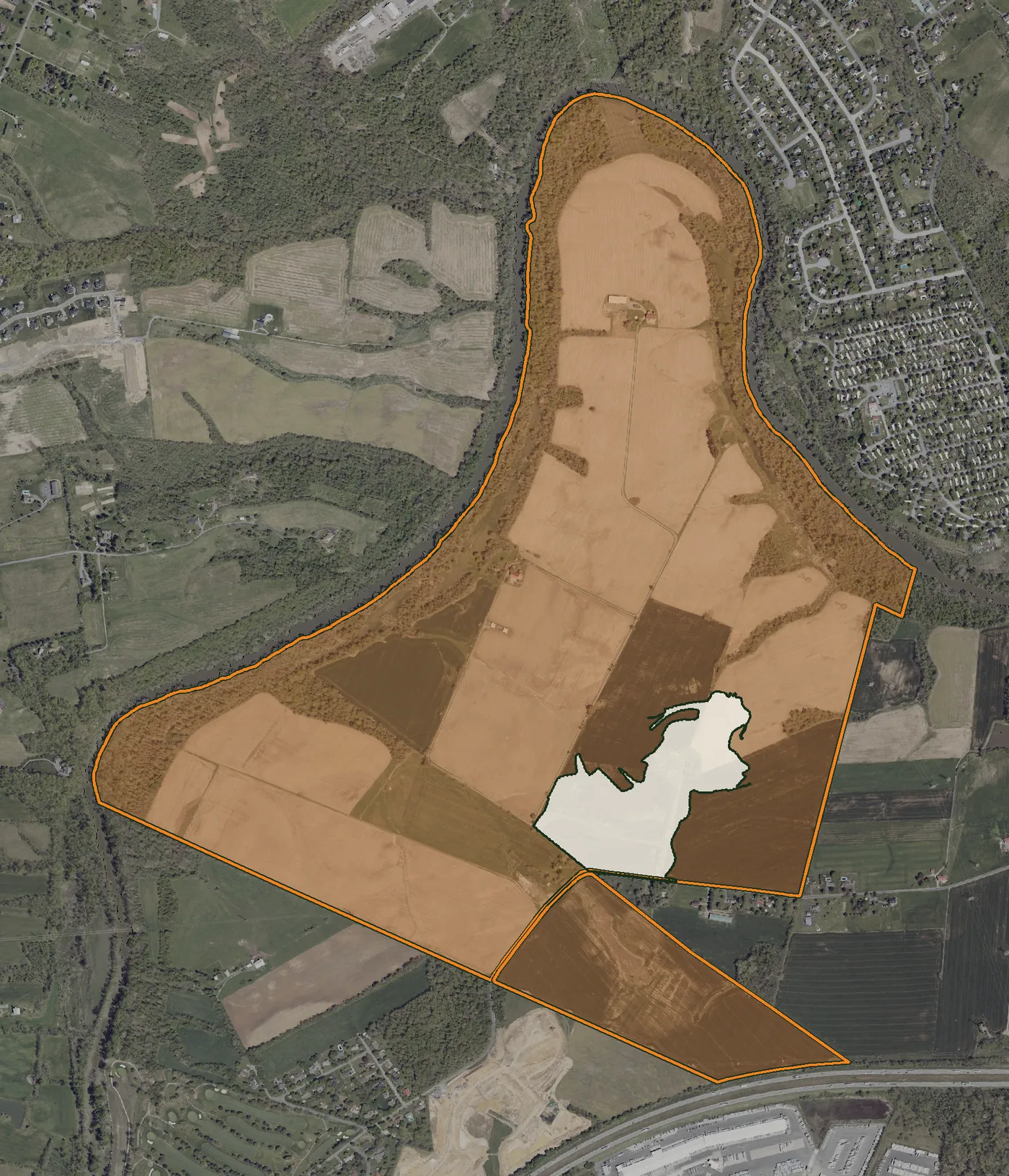
Traced from the permit's own plans: the Cumberland Knoll erosion control plan, and the permit boundary sheet from the December 2025 amendment. Aerial imagery: USGS and USDA.
Every large construction site in Pennsylvania needs a stormwater permit, the permit that controls runoff and erosion while the ground is torn up. PAX-1 does not have one of its own.
It is building on a permit first issued for Cumberland Knoll, a 58 home subdivision on 15.3 acres, with a permit area of 36 acres. Today it covers 693 acres, 19 times the area.
In July 2025, the Cumberland County Conservation District, which approves stormwater permits here, told the state Department of Environmental Protection (DEP) that the project would bring “4+ amendments throughout the project” and that tracking them would be “extremely difficult and confusing.” The District approved every one. Quoted in our appeal
A-1
August 5, 2025
Filed as a transfer
The permit passes from the old residential developer to Carlisle Development Partners, the developer's company.
Approved for a stone laydown yard serving PPL's substation work, though the District's own table takes impervious cover, ground that rain can't soak into, from 0.57 acres to 13.77. No notice is published.
Approved seven days after the District called the application complete and said technical review would begin. The permit site grows from 36 acres to 693, and the project description now reads a 693-acre data center.
technical deficiencies county reviewers found in the Phase 1A and 1B stormwater plans in March 2026. In May, 21 were still not adequately addressed, and 3 new ones had been added.
documents in the Right-to-Know response that reached a resident on May 18, 2026. It was the first notice anyone outside the agencies had of what the old permit now covers.
The stormwater permit is only one of the approvals PAX-1 needs. DEP's permit tracker lists 21 for the project. As of September 23, 2026, 8 had been issued, 5 were pending, and 8 had not yet been submitted. Each one is reviewed on its own terms.
Six general permits for utility lines, a road crossing and repairs, applied for one at a time since January 2025. DEP lists one more stream and wetland permit as not yet submitted.
In January 2026 DEP required full sewage planning for the campus's industrial wastewater, plus a separate permit for the cooling-water pump station. The planning module reached DEP in September 2026.
The Township's ordinance requires the commission's approval for a project that consumes 20,000 gallons a day or more, and PAX-1 is set to draw up to 400,000. The developer claimed an exemption. In May 2026 the commission said PAX-1 is expected to consume at least 20,000 gallons a day for part of the year, that it needs the commission's approval before operating, and that no application had been filed.
The only full assessment of the whole project. It was written by LIVIC Civil, whose principal, Justin Ross, is also chief operating officer of Pennsylvania Data Center Partners, one of the two companies behind PAX-1.
Blasting and earthmoving were underway before the land development approvals were issued. DEP has cited two violations on the site, and the county Conservation District two more.
August 7, 2025
A sewer line through a wetland, with no permit
In July 2025 a DEP inspector found a sewer line for the Cumberland Knoll subdivision already installed through a wetland on one of the parcels, with no Chapter 105 permit, the state permit for building in streams and wetlands. DEP issued a notice of violation to Club Road Properties, Cumberland Knoll's developer, and the excavator, citing the Clean Streams Law. The data center developer, which bought the parcel that month, agreed to apply for the permit after the fact. The line went in first, and the permit came later.
A blast at the site measured 140.5 dBL at a home on Sassafras Lane, against a state limit of 133 for airblast, the pressure wave a blast sends through the air. Airblast is measured differently from everyday noise, so these numbers do not compare to the 70-decibel noise limit. DEP cited the blasting contractor on June 24 for “failure to control airblast.” The developer's PAX-1 website still says DEP inspections “confirmed that measures taken exceed the minimum requirements.”
Erosion controls overtopped, and bare ground left open
Twenty days after DEP said it saw no pattern of violations, a Conservation District inspection under the permit's fourth amendment cited two more: erosion controls not maintained, with filter socks overtopped and undercut, and bare ground not stabilized. The report says the violations it notes “constitute unlawful conduct” under the Clean Streams Law.
“The people have a right to clean air, pure water, and to the preservation of the natural, scenic, historic and esthetic values of the environment. Pennsylvania’s public natural resources are the common property of all the people, including generations yet to come. As trustee of these resources, the Commonwealth shall conserve and maintain them for the benefit of all the people.”
The Pennsylvania Constitution gives every person the right to clean air, pure water, and the natural beauty around them. It makes the government a trustee, bound to protect these things for everyone, including the generations not yet born.
Trustee is the key word: the government is not free to hand these resources away. In 2013 the Pennsylvania Supreme Court ruled that a government body has to weigh the environmental impact before it acts, not after.
DEP carries the same duty as trustee. Our appeal argues that DEP and the county Conservation District approved 300 acres of earthmoving, draining toward the Conodoguinet Creek, without the showings the rules require on how much runoff it would send and how clean it would be, and so failed that duty.
We've appealed the stormwater permit to the Environmental Hearing Board#
We took all four amendments to the Environmental Hearing Board. If the permit is pulled or narrowed, construction could stop or slow while the developer starts over with the right permit and a real public process.
Before a state boardPennsylvania Environmental Hearing Board
The stormwater permit appeal
Asks the Board to revoke the permit coverage for the data center's first phases, or to require an individual permit before more earth is disturbed.
What's next: The appeal is before the Environmental Hearing Board, an independent panel that reviews DEP decisions. Discovery closes February 10, 2027.