They changed the nature of this community forever, without weighing what it means for the residents, livestock, wildlife and visitors who share it. PAX-1 puts 16 data center buildings on 694 acres of farmland beside the Conodoguinet Creek, a third of a mile from the Appalachian Trail.
“I understand that Country Club Road is not gonna be a good place to live for the next five years.”
Supervisor Phil Neiderer, Board of Supervisors meeting, July 1, 2026. Watch it
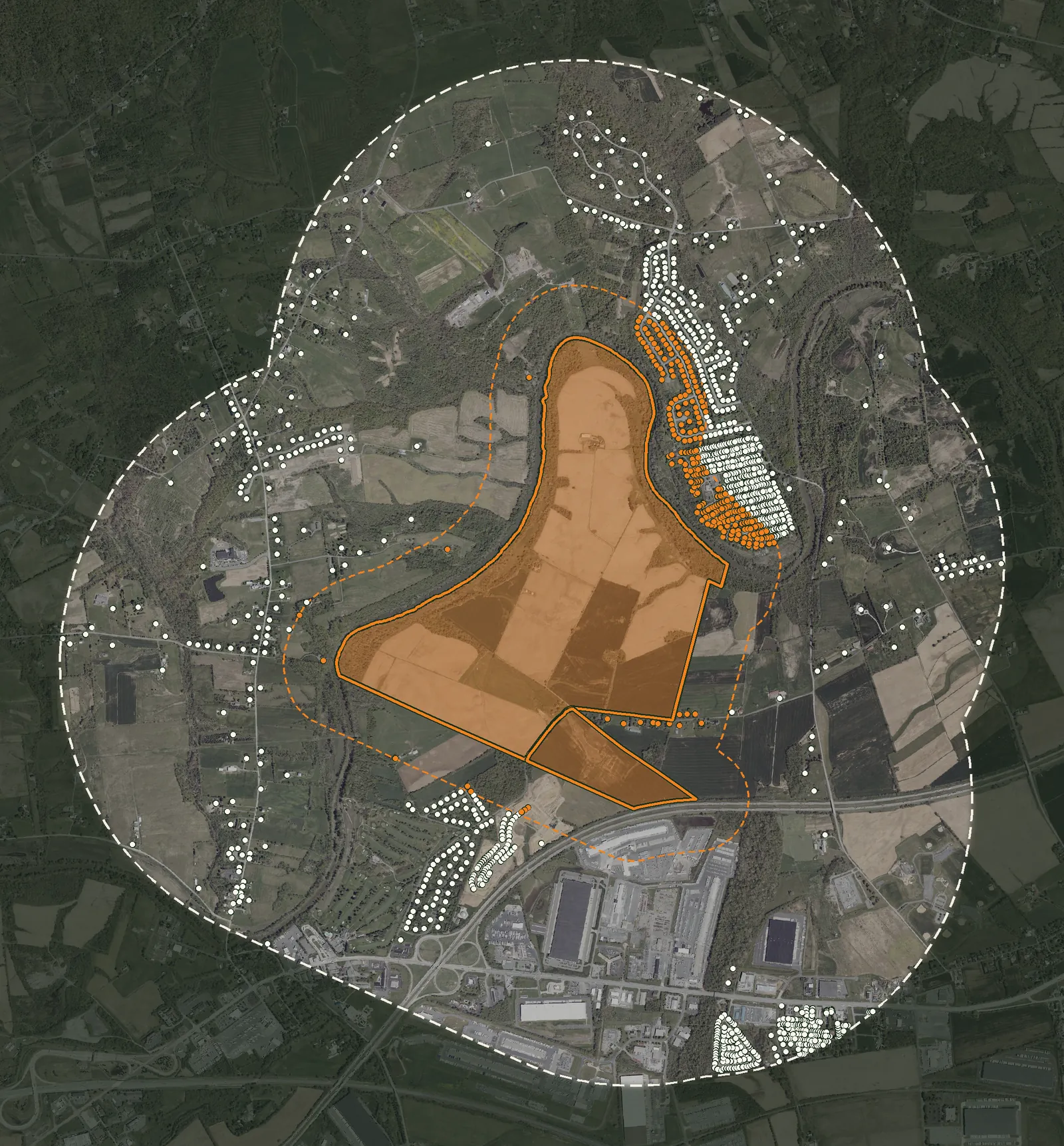
PAX-11 mile1,000 feet
1 mile
A home within 1,000 feetA home within a mile
260
homes within 1,000 feet of the site, about the length of three football fields. The nearest is about 80 feet from the property line.
1,333
homes within a mile of the site, in neighborhoods and on farms on both sides of the Conodoguinet Creek. This is where we live.
14%
of the homes in the mile are across the creek in Silver Spring Township, whose residents may not speak at Middlesex's meetings Watch a neighbor turned away
39%
of all the homes in Middlesex Township are within the mile
Homes from Cumberland County's 911 address records. Buildings, drives, generator yards, substations and the laydown yard from the developer's own plans. Aerial imagery: USGS and USDA.
Homes from Cumberland County's 911 address records. Buildings, drives, generator yards, substations and the laydown yard from the developer's own plans. Aerial imagery: USGS and USDA.
In its place, a massive compound stands, devouring our water and electricity.
It is allocated as much water as 2,367 homes use.
The municipality has allocated the campus 400,000 gallons of water and 273,000 gallons of sewer capacity a day. Engineers say that much water equals what 2,367 homes use.
The water PAX-1 is allocated each day2,367 homes' worth
Its own consultant put the peak at 3 to 4 million gallons a day.
The developer's own water consultant wrote in September 2025 that the campus could need 3 to 4 million gallons a day at its peak, “the vast majority, if not the entirety” of it from “groundwater supply wells.” The Township's approvals now bar wells on the site, and the developer has agreed not to ask for more than 400,000 gallons a day “based on” the water authority's “current capacity.”
The water authority says it will need new sources.
In a December 2025 memo that counts the campus, the Middlesex Township Municipal Authority, which supplies the public water here, says new sources “will be necessary to meet future MTMA customer demands.” In September 2026 the Susquehanna River Basin Commission tabled the authority's application for a second well.
About 16 of the 260 homes within 1,000 feet of the site, 11 of them on Country Club Road, are likely on private wells. The other 244 are likely on the authority's public water.
The state's blasting rules require no well survey.
Pennsylvania's rules for construction blasting require no survey of nearby wells. The Township's engineer asked twice for one, in October and December 2025. In a side letter approved on September 2, 2026, the developer agreed to test wells within 1,500 feet “before further blasting,” and to repair or replace any that blasting harmed, for owners who sign a separate agreement.
9×the electricity of all the homes in Cumberland County
Our bills rise as we compete for what's left.
1.35 gigawatts, and a claim it will offset our rates.
The developer's announcement puts PAX-1 at 1.35 gigawatts of capacity, expandable to 1.8. Its PAX-1 website says the project “will offset consumer electrical rates for the first time in decades.”
Data centers added $29.4 billion to the grid's capacity costs.
The independent market monitor for PJM, which runs our regional grid, found that data centers added $29.4 billion to the region's capacity costs, the price of keeping enough power plants ready, for June 2025 through May 2029. PPL says higher capacity prices have added about $20 a month to its average home's bill.
In Virginia: State auditors estimated that data center growth could raise a typical Dominion Energy household's generation and transmission costs by $14 to $37 a month by 2040, not counting inflation.
The peace of the Conodoguinet Creek is replaced by 24/7 mechanical noise.
The 70 decibel limit lifts during a power outage.
Middlesex limits data center noise to 70 decibels at the property line, and the limit “does not apply during a time of power outage.” The developer's own study predicts about 50 at the edge of the site nearest the buildings, with its fans at full load.
The Township's consultant could not check the noise study.
The Township's rules “don't specifically address low frequency,” its zoning officer said. In August 2026 the Township's review consultant still could not check the study's model, because the developer would not share the specifications of the generators and air handlers without naming its tenant.
Health: To protect sleep, the World Health Organization advises no more than 45 decibels outside homes at night and 30 inside, and lower still when much of the sound is low-frequency.
A 2016 review of the research found some links between low-frequency noise and annoyance, sleep problems, trouble concentrating and headaches.
Children: The American Academy of Pediatrics says environmental noise can affect children's learning and sleep.
The clearest evidence comes from schools near airports, where the World Health Organization finds children's reading falls one to two months behind for every 5 decibels of added noise. Research on low-frequency noise and infrasound in children is thin, and none of it looks at a data center.
Farm animals: Sudden loud noise stresses cattle, and older studies found it can cut their milk.
Cumberland County is sixth among Pennsylvania's 62 milk-producing counties in milk sales, with about 19,800 milk cows. The international standard for dairy cattle welfare says sudden, unexpected noise should be kept to a minimum to prevent stress and fear.
In Virginia: State auditors found that data centers' low-frequency noise “is not fully captured” in A-weighted decibels, the usual measure, which discounts low sounds, so it rarely breaks noise limits.
Prince William County now sets a separate limit, in C-weighted decibels, which count low sounds nearly in full, for a steady “whine, hum, rumble, or buzz.”
Sixteen buildings, 80 feet tall, scar the scenic beauty of the Appalachian Trail.
The state found it will block the Trail's views.
In January 2026 the State Historic Preservation Office disagreed with the developer's finding of no adverse effect. It found the project will have an adverse effect on the Appalachian Trail, by blocking the Trail's views of open space.
The state rejected the developer's screen of 100 evergreens.
In March it rejected the developer's plan to plant 100 evergreens along the Trail corridor, because the trees could themselves block historic views of the surrounding farmland.
The Clean Air Board of Central Pennsylvania told the Supervisors that Cumberland County's air already gets an F from the American Lung Association for short-term particle pollution.
No air permits had been applied for by September 23.
The developer's engineer told the Supervisors in July 2026 that each generator will have its own diesel tank, with no central storage. As of September 23, 2026, DEP's permit tracker listed the air quality permits and the storage tank permitting as not yet submitted.
In May's heat wave, the grid was allowed to switch data centers onto diesel.
In May 2026, during a heat wave, the U.S. Department of Energy authorized PJM, our regional grid operator, to direct data centers onto their backup generators as a last resort before cutting power to customers.
Health: The World Health Organization's cancer agency found in 2012 that diesel exhaust causes lung cancer. After studying the data centers around Quincy, Washington State's environmental agency advised local planners to avoid zoning homes near clusters of them.
It found the risk in Quincy low, because power outages there last less than an hour a year and the data centers sit away from most homes. In 2016 they emitted about 12 percent of the diesel particles their permits allow. If they ran as much as their permits allow, clusters of them could expose a few nearby homes to diesel exhaust at levels like those along the town's main roads.
In Virginia: Virginia Commonwealth University researchers mapped the backup generators at 138 Northern Virginia data centers. Most run them rarely, but some already emit 30 percent or more of what their permits allow, and some clusters out-pollute a nearby power plant.
At their permit limits, the region's data centers would put out about half of the particle pollution from its power plants and other fixed sources. State auditors found the industry's actual emissions in 2023 were 7 percent of what permits allow, and that in a long outage, if every Northern Virginia data center reached its limit, they would emit over 9,000 tons of nitrogen oxides, about half of what the region typically emits in a year from all sources.
The Park Service and the Trail Conservancy both raised the lighting.
The National Park Service and the Appalachian Trail Conservancy both raised light pollution with the Township. The Park Service wrote that the campus lighting “will likely impact the appreciation of dark night skies/stargazing in the Trail's protected corridor.”
The dark-sky rules don't cover PPL's part of the site.
The Phase 1B developer's agreement, as read aloud at the August 19 meeting, requires dark-sky lighting on the developer's property, but not in the areas PPL controls. The Supervisors approved it on September 2. Supervisor Neiderer said in May that PPL, as a public utility, is not bound by the Township's zoning or its lighting rules.
The label has already been proposed for more land.
Middlesex
214 acres
By December 2025, a property owner had asked Middlesex to stretch the Data Center Overlay onto 214 more acres along Harrisburg Pike, most of it farmland. The county planning department recommended disapproval. In February 2026 the Supervisors put new data center zoning on hold until the Township adopts a new comprehensive plan. The hold does not undo PAX-1's zoning.
In county courtCumberland County Court of Common Pleas
The land use appeals
Ask the court to reverse the Supervisors' plan approvals and send the plans back to them to be denied.
What's next: Our brief on the Phase 1B approval is due November 2, 2026, and the court will hear oral argument on January 12, 2027. The Phase 1C and Phase 2 appeal and the September 2 appeal are with the county court.
Before a state boardPennsylvania Environmental Hearing Board
The stormwater permit appeal
Asks the Board to revoke the permit coverage for the data center's first phases, or to require an individual permit before more earth is disturbed.
What's next: The appeal is before the Environmental Hearing Board, an independent panel that reviews DEP decisions. Discovery closes February 10, 2027.